
We Kept Hearing the Same Complaint. The Solution Was Re-Auth.
See Venn first in Google Search
Add as a preferred source on Google
There’s a version of product management where you build things because they’re technically impressive, or because they fit neatly into your roadmap, or because a big customer asked for them. That version is tempting. It’s also usually wrong.
The best features start somewhere simpler: you found out your product was adding friction to someone’s morning instead of removing it.
Start With the Problem. Always.
When we set out to build Venn’s new re-authentication feature – what we internally call re-auth – we didn’t start with a technical spec. We started with a pattern we kept hearing from our users.
Every morning, they opened Blue Border™ and had to start from scratch. Log back in. Reopen every app and document. Rebuild every browser tab. And then, eventually, get to work. For people who spend their entire workday inside our product, that friction wasn’t a minor inconvenience; it was the first experience they had every single day.
We also had an advantage most product teams don’t: we use Blue Border™ ourselves, all day, every day. That means we weren’t just hearing about the problem secondhand. We were living it. And once something is part of your daily routine, you feel it differently than you do in a survey response.
The feedback was consistent and clear. This wasn’t a one-off complaint; it was a recurring theme in surveys, in interviews, in casual conversations with customers. The morning login experience was a real pain point, and we owned it.
Working With Engineering to Find the Right Solution
Once a problem is prioritized, the real work begins, and this part is often harder than anyone expects.
The instinct is to jump straight to a solution. But good product work means walking in your customers’ shoes; understanding their personas, their actual workflows, their jobs to be done, and their habits – and then trying to find a solution that fits all of those. And wherever possible, one that aligns with what people already know how to do, so they don’t have to learn something new just to get back to work.
We looked at how other operating systems handle a similar challenge. When your laptop goes to sleep, it doesn’t log you out of everything and ask you to rebuild your session from scratch; it picks up roughly where you left off. That concept of “sleep” was our north star. We adapted it, tested it, iterated on it, and frankly failed a few times before we found the right approach. (That failure process is probably a blog post of its own.)
What mattered was the testing loop: start with a small group of users, gather real feedback, bring those insights back into the design, and expand from there. We didn’t ship and hope. We shipped to learn, and then we improved.
What We Actually Built
The old behavior was a blunt instrument: after a set period of inactivity, your session expired. Full stop. You came back to your desk and had to start over. That’s not because we didn’t care about the experience – it’s because maintaining the security controls our customers depend on and meeting their compliance requirements, while also preserving session state across different platforms and OS versions, is genuinely hard. It took research, design iterations, and making sure we had the right technology to pull it off consistently before we could ship something we trusted.
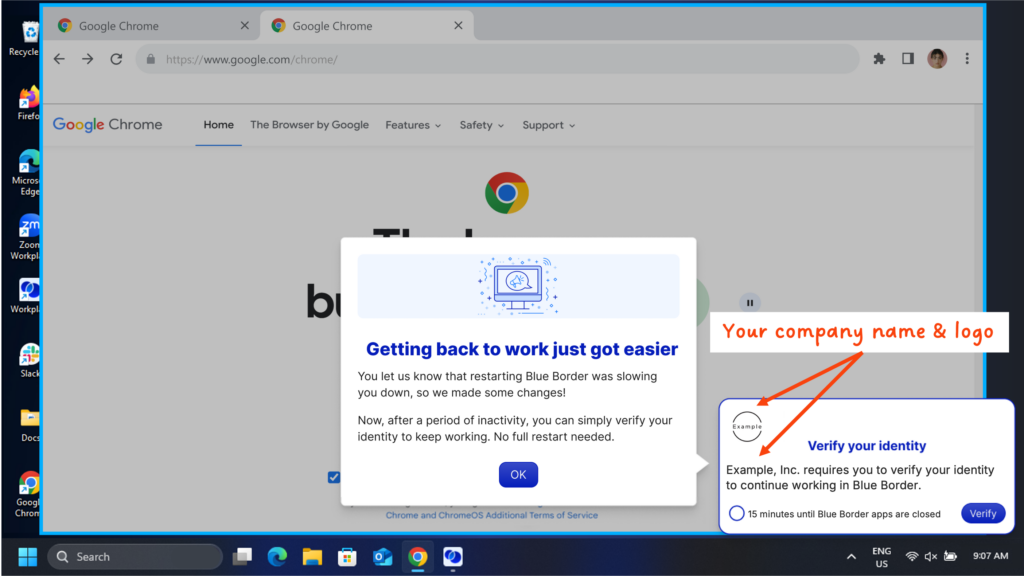
What we landed on is this: when you’ve been away for a defined period, Blue Border™ prompts you to verify your identity – and then returns you to your session exactly as you left it. Apps still open. Tabs still there. The security check still happens; it just doesn’t cost you your entire context. That’s the core of re-auth, and it’s the thing we’re most proud of. And if your organization requires MFA at sign-in, that same flow applies when users reauthenticate – same identity provider, nothing new to learn.
Admins also get two additional controls to work with: the ability to force locking the device after a shorter interval of inactivity, and the option to also require full session expiry for teams or user groups with stricter security requirements.
For organizations with mixed security needs, all of this is configurable at the group level. High-sensitivity teams can stay on full session expiry. Everyone else gets their morning back.
The Result
Re-auth is now rolling out to all of our customers.
What does that mean in practice? It means that when you open Blue Border™ in the morning, you’re not starting from zero. Your session is waiting for you. Your apps are there. Your tabs and documents are there. You can actually sip your coffee before you get on your computer… and that’s not a small thing. Those few extra minutes of unhurried time before the workday fully starts? We built that.
That’s the version of product management I believe in. Not the one that optimizes for impressive, or technically complex, or visible. The one that makes someone’s Tuesday a little better than their Monday.

Dvir Shapira
Chief Product Officer
More Blogs




Any worker. Any laptop. Any AI workflow. Fully secured.
Schedule a demo to see how Blue Border™ secures company data and apps without shipping laptops, running VDI, or managing personal endpoints.