
Top 8 Enterprise Solutions for Real-Time AI Monitoring and Defense

See Venn first in Google Search
Add as a preferred source on Google
TL;DR: Real-time AI monitoring and defense solutions watch AI activity as it happens and block risky prompts, data movement, and agent actions. Best for AI use on unmanaged devices: Venn; best for workforce AI access control: Zscaler; best for AI app and agent runtime defense: Prisma AIRS; best for agentic detection and response: Noma Security.
What Are Real-Time AI Monitoring and Defense Solutions?
Enterprise solutions for real-time AI monitoring and defense combine continuous telemetry analysis, behavior-based anomaly detection, and automated containment to secure AI assets and prevent data leaks.
Real-time AI monitoring and defense solutions are specialized security systems designed to track, analyze, and protect artificial intelligence environments as they operate. Unlike traditional monitoring tools, these solutions focus on the unique risks associated with AI models, agents, and workflows. They provide immediate visibility into AI-driven processes, detecting suspicious activity, policy violations, or anomalous behaviors as they occur. Their core function is to offer continuous oversight, ensuring that AI systems remain secure and compliant with organizational and regulatory standards.
These solutions operate at multiple layers, including the application, data, and infrastructure levels. They monitor real-time interactions between users, data, and AI agents, allowing organizations to respond instantly to emerging threats or operational issues. By integrating with enterprise systems, real-time AI monitoring and defense tools enable automated responses, such as blocking harmful actions, isolating compromised components, or enforcing stricter access controls. This real-time capability is critical for enterprises leveraging AI at scale, where delays in detection or mitigation can result in significant financial, reputational, or regulatory consequences.
Core capabilities of real-time AI monitoring and defense solutions:
- Continuous AI asset discovery: Maintains a real-time inventory of models, agents, datasets, APIs, and shadow AI deployments to support monitoring, compliance, and risk reduction.
- Secure isolation of AI workflows: Segments AI workloads, data, and resources to prevent unauthorized access, lateral movement, and cross-contamination while limiting incident impact.
- AI agent and tool-use monitoring: Tracks agent behavior, tool invocations, and API activity to detect misuse, enforce boundaries, and identify unauthorized integrations.
- Endpoint-level enforcement: Applies AI security controls directly on endpoints to block risky activity, prevent data exposure, and support rapid incident response.
- Identity-based access governance: Continuously validates user, agent, and service permissions to enforce least privilege and detect suspicious access or privilege changes.
- Real-time data loss prevention: Inspects AI prompts, responses, documents, and traffic to detect sensitive data and prevent accidental or deliberate disclosure.
In this article:
- AI Monitoring and Defense Solutions at a Glance
- Why Enterprises Need Real-Time AI Monitoring and Defense
- Core Capabilities of Enterprise Real-Time AI Monitoring and Defense Solutions
- Notable Real-Time AI Monitoring and Defense Solutions
AI Monitoring and Defense Solutions at a Glance
The table below summarizes the key differences between the solutions covered in this guide, including where each one fits best and what to weigh before buying. We explore each of them in more detail in the sections that follow.
| Category | Solution | Best For | Key Strengths | Things to Consider |
| Endpoint and Workforce AI Monitoring | Venn | AI use and company data on unmanaged or BYOD computers | Local secure enclave with DLP and approved-AI-only controls | Performance varies by device; limited customization |
| Endpoint and Workforce AI Monitoring | Zscaler AI Security | Inline control of workforce AI access at scale | Shadow AI discovery, inline DLP, runtime guardrails | Latency in some regions; complex policy setup |
| Endpoint and Workforce AI Monitoring | Netskope One AI Security | Unified visibility across all enterprise AI traffic | Shadow AI and MCP discovery, real-time prompt inspection | Complex deployment; premium pricing |
| Endpoint and Workforce AI Monitoring | WitnessAI | Network-level governance of employee and agent AI use | Intent-based policy engine, bidirectional runtime defense | Coverage depends on network path; pricing not public |
| AI Application, Model, and Agent Runtime Defense | Palo Alto Networks Prisma AIRS | Securing AI apps, models, and agents end to end | AI Gateway, runtime safeguards, model scanning, red teaming | Some features still maturing; complex packaging |
| AI Application, Model, and Agent Runtime Defense | Cisco AI Defense | Enterprises building and using AI across multicloud | Network-embedded guardrails, validation, asset inventory | Best value inside a Cisco stack; dense documentation |
| AI Application, Model, and Agent Runtime Defense | HiddenLayer AI Runtime Security | Runtime defense for AI apps, coding agents, workflows | Agentic runtime visibility with inline block and redact | Model-centric scope; strongest as a full platform |
| AI Application, Model, and Agent Runtime Defense | Noma Security Runtime Protection | Real-time detection and response for AI and agents | Context-aware enforcement at the point of execution | Enterprise-scoped; pairs with posture module |
Related content: Read our guide to the best AI security tools.
Why Enterprises Need Real-Time AI Monitoring and Defense
Detecting Threats During AI Interactions
AI-driven applications are dynamic by nature, often interacting with users, data sources, and other systems in real time. This dynamic environment creates opportunities for adversaries to launch attacks, such as prompt injections or adversarial inputs, which can manipulate AI outputs or compromise underlying models. Real-time monitoring enables enterprises to identify and respond to these threats as they occur, rather than relying on delayed detection through periodic audits or manual reviews. The ability to detect anomalies in AI interactions is essential for maintaining the integrity and reliability of AI-driven services.
Effective threat detection requires monitoring both the inputs and outputs of AI models, as well as the context in which interactions occur. Real-time solutions use advanced analytics and behavioral baselines to flag deviations from normal activity, alerting security teams to potential incidents. By correlating events across the AI stack, these systems provide a comprehensive view of risks, enabling faster investigation and response. This proactive approach minimizes the window of exposure and helps organizations prevent attacks from escalating into larger security incidents.
Preventing Sensitive Data Exposure
AI systems frequently process large volumes of sensitive data, making them prime targets for data leakage or unauthorized access. Real-time monitoring and defense solutions are designed to prevent exposure by continuously inspecting data flows within AI workflows. These tools identify attempts to extract, exfiltrate, or misuse confidential information, providing automated mechanisms to block or redact sensitive content before it leaves the controlled environment. This level of oversight is crucial for organizations handling regulated data, such as personally identifiable information (PII) or intellectual property.
Beyond data inspection, real-time defense solutions enforce data handling policies throughout the AI lifecycle. They monitor how data is accessed, transformed, and shared between models, agents, and external systems, ensuring compliance with privacy regulations and internal controls. By integrating with data loss prevention (DLP) technologies, these solutions provide layered protection, stopping both inadvertent and malicious disclosures. This comprehensive approach reduces the risk of reputational damage, legal penalties, and loss of customer trust associated with data breaches.
Controlling Autonomous AI Agents
Autonomous AI agents can make decisions and take actions independently, increasing the risk of unintended or harmful behavior. Real-time monitoring and defense solutions address this challenge by providing continuous oversight of agent activities, ensuring that actions align with organizational policies and ethical guidelines. These tools track the decisions made by AI agents, monitor tool usage, and enforce guardrails to prevent unauthorized or dangerous operations. By maintaining control over autonomous processes, enterprises can safely leverage AI automation without sacrificing governance.
Effective control also involves the ability to intervene when agents deviate from expected behavior. Real-time solutions enable security teams to pause, modify, or terminate agent activities in response to detected anomalies or policy violations. This capability is essential for preventing cascading failures or the exploitation of AI agents by external attackers. By combining automated enforcement with human oversight, organizations can strike a balance between autonomy and accountability, unlocking the full potential of AI while managing operational risks.
Maintaining Visibility Across Distributed AI Environments
Modern enterprises often deploy AI solutions across hybrid and multi-cloud environments, leading to fragmented visibility and increased management complexity. Real-time AI monitoring and defense solutions provide centralized visibility into all AI assets, regardless of where they reside. These tools aggregate telemetry from diverse environments, creating a unified view of AI activity and security posture. This comprehensive visibility is essential for detecting threats, enforcing policies, and demonstrating compliance across distributed infrastructures.
Maintaining visibility also supports incident response and forensic investigations. When a security event occurs, real-time monitoring solutions provide detailed logs and contextual information, enabling teams to trace the root cause and assess the impact quickly. By correlating data from multiple sources, organizations can identify patterns and emerging risks that may go unnoticed in isolated environments. This holistic approach allows enterprises to manage AI security at scale, ensuring consistent protection and oversight as AI adoption grows.
Core Capabilities of Enterprise Real-Time AI Monitoring and Defense Solutions
Continuous AI Asset Discovery
Continuous AI asset discovery enables organizations to maintain an up-to-date inventory of all AI-related resources, including models, agents, datasets, and APIs. This process is essential for identifying shadow AI deployments, unmanaged models, or unauthorized integrations that may introduce security risks. Automated asset discovery tools scan enterprise environments, cataloging AI assets as they are created, modified, or retired. This real-time awareness is the foundation for effective monitoring, risk assessment, and policy enforcement across the AI lifecycle.
Ongoing asset discovery also supports compliance efforts by ensuring that all AI systems are accounted for and subject to appropriate controls. As organizations scale their AI initiatives, manual tracking becomes impractical, increasing the risk of overlooked vulnerabilities. Automated discovery addresses this gap, enabling security teams to detect changes in the environment and respond to emerging threats quickly. By maintaining visibility into the full AI asset landscape, organizations can prioritize security investments and reduce the attack surface.
Secure Isolation of AI Workflows
Secure isolation of AI workflows involves segmenting AI processes and resources to prevent unauthorized access, lateral movement, or cross-contamination between models and datasets. This capability is critical in multi-tenant or shared environments, where different teams or business units may operate separate AI workloads. Real-time monitoring and defense solutions enforce isolation through network segmentation, containerization, or policy-based controls, ensuring that sensitive data and models remain protected from internal and external threats.
Isolation also supports incident containment by limiting the blast radius of potential attacks. If a compromise occurs within one workflow, secure isolation prevents adversaries from accessing other critical assets or propagating malware throughout the environment. This approach reduces the risk of widespread damage and simplifies recovery efforts. By integrating isolation controls with real-time monitoring, organizations can enforce least-privilege access and maintain trust in the integrity of their AI operations.
AI Agent and Tool-Use Monitoring
Monitoring AI agents and their use of tools is vital for understanding how autonomous processes interact with enterprise systems. Real-time monitoring solutions track agent behaviors, tool invocations, and API calls, providing granular visibility into operational patterns. This oversight enables organizations to detect misuse, abuse, or deviations from expected workflows, supporting proactive risk management. By continuously analyzing agent activity, security teams can identify emerging threats and enforce appropriate controls.
Tool-use monitoring also helps organizations optimize resource allocation and identify inefficiencies in AI operations. By understanding how agents leverage various tools and services, enterprises can refine workflows, reduce costs, and improve performance. Additionally, monitoring enables the detection of unauthorized tool usage or integration with unapproved third-party services, which could introduce security or compliance risks. This comprehensive approach ensures that AI agents operate within defined boundaries and contribute positively to organizational goals.
Endpoint-Level Enforcement
Endpoint-level enforcement extends AI security controls directly to the systems where AI applications, agents, and users operate. Instead of relying only on centralized monitoring, these controls inspect AI-related activity on endpoints in real time. They can block unauthorized applications, prevent risky prompt submissions, restrict access to sensitive files, and stop AI tools from communicating with unapproved external services. This reduces the risk of data exposure and policy violations before they reach enterprise AI platforms.
Real-time enforcement also improves incident response by acting immediately when suspicious behavior is detected. Security teams can isolate compromised endpoints, terminate malicious AI processes, or apply temporary restrictions without disrupting the entire environment. By combining endpoint telemetry with centralized monitoring, organizations gain better visibility into user behavior and can enforce consistent security policies across managed devices.
Related content: Read our article about endpoint AI security.
Identity-Based Access Governance
Identity-based access governance ensures that users, AI agents, and services receive only the permissions required to perform their tasks. Real-time monitoring solutions continuously validate identities, roles, and access requests, helping organizations enforce least-privilege access across AI environments. This reduces the likelihood of unauthorized model access, excessive permissions, or compromised accounts being used to manipulate AI systems or retrieve sensitive information.
These solutions also monitor changes in identity and privilege over time. They detect unusual authentication patterns, privilege escalation attempts, and access from unexpected locations or devices. When suspicious activity is identified, automated policies can require additional authentication, revoke temporary privileges, or block access entirely. Continuous governance strengthens AI security while supporting regulatory compliance and audit requirements.
Real-Time Data Loss Prevention
Real-time data loss prevention protects sensitive information as it moves through AI applications, models, and agent workflows. These solutions inspect prompts, responses, uploaded documents, and API traffic for confidential data such as PII, financial records, source code, or intellectual property. When sensitive content is detected, policies can automatically block transmission, mask specific values, or require approval before the data is shared outside approved environments.
Modern AI-focused DLP extends beyond simple pattern matching by understanding the context of AI interactions. It identifies attempts to extract sensitive information through repeated prompts, detects abnormal data access patterns, and monitors how AI-generated content is distributed. By combining contextual analysis with automated enforcement, organizations can reduce the risk of accidental disclosure and deliberate data exfiltration while enabling employees to use AI tools safely.
Notable Real-Time AI Monitoring and Defense Solutions
How we selected these solutions: We shortlisted enterprise AI monitoring and defense solutions based on their ability to discover AI assets and shadow AI, monitor prompts, responses, and agent activity in real time, enforce data loss prevention and access controls during live AI interactions, and block runtime threats such as prompt injection, unsafe agent actions, and sensitive data exposure.
Endpoint and Workforce AI Monitoring and Defense
1. Venn Blue Border

Best for: AI use and company data on unmanaged or BYOD computers
Strengths: Local secure enclave with DLP and approved-AI-only controls
Things to consider: Performance varies by device; limited customization options
Venn’s Blue Border creates an isolated, IT-controlled work environment that runs locally on any PC or Mac, whether the device is company-managed, unmanaged, BYOD, or contractor-owned. It is not a virtual desktop and involves no hosting or virtualization. Work applications run natively inside the enclave, marked visually by a blue line around the application window.
That boundary is where AI monitoring and enforcement happen. AI tools used inside Blue Border operate under corporate policy, while browser-based and natively installed AI tools outside the enclave are blocked from touching company data, whether through direct upload or copy and paste. Policy is set once and applied across every worker and device type.
Key features include:
- Application-layer secure enclave: Work apps, data, networking, and AI workflows run inside a company-controlled enclave that acts like a firewall around each application window, isolating business activity from personal use on the same computer.
- AI access control at the OS level: IT defines which AI tools are permitted inside the work environment and which specific tenants can be accessed. Unauthorized AI tools are blocked from company data without requiring a VPN or an enterprise browser.
- DLP and exfiltration controls: Policies govern what data can be copied, pasted, printed, uploaded, screen-captured, or entered into an AI tool. Enforcement happens at the application and data layer rather than at the network layer.
- Session-level AI usage visibility: IT sees AI tool usage for applications running in the enclave across managed devices, personal laptops, BPO-managed devices, and offshore endpoints, with real-time insight into where, when, and from what device a user accessed an app or sensitive data.
- Audit-ready compliance logging: Activity logs support SOC 2, HIPAA, PCI, FINRA, and emerging AI governance requirements. Venn is built to comply with SOC 2 Type II, HIPAA, SEC, FINRA, NAIC, NYS DFS, Mass 201 CMR 17.00, CMMC, and PCI.
- Privacy separation outside the boundary: Activity outside Blue Border, including personal AI tools and personal files, cannot be seen, tracked, or monitored by the company or by Venn.
- Deployment without infrastructure: Blue Border requires no backend infrastructure, no VDI, and no device management layer, so remote workers and contractors install it on an existing device and IT can offboard with a remote wipe of the Venn disk.
Limitations (as reported by users on G2):
- Endpoint performance: Some users report slower response and higher resource consumption on certain devices, including machines that meet the stated hardware requirements.
- Application stability: A few reviewers describe intermittent stability issues with specific desktop applications, particularly after updates.
- Customization scope: Reviewers note that customization options in some policy areas are more limited than they would like.
Source: Venn

2. Zscaler AI Security

Best for: Inline control of workforce AI access across a zero trust platform
Strengths: Shadow AI discovery, inline DLP, and runtime guardrails at scale
Things to consider: Latency in some regions; complex initial policy configuration
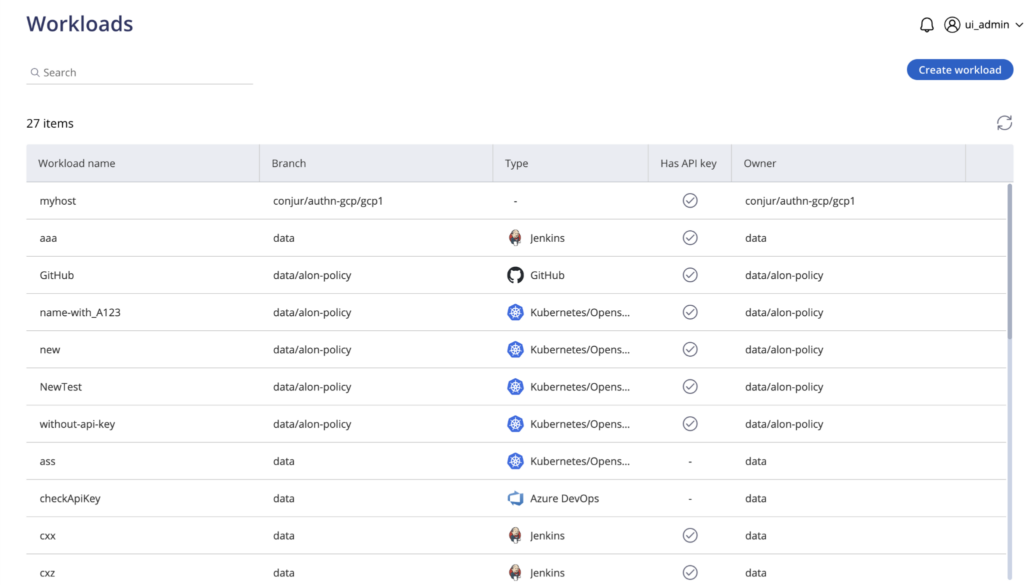
Zscaler AI Security is a unified set of AI controls delivered through the Zero Trust Exchange rather than a standalone appliance or agent. It covers four areas: discovering AI assets and shadow AI, controlling access to AI applications, testing and protecting AI apps and infrastructure, and governing the resulting AI footprint for compliance.
Because inspection happens inline, prompts and responses are examined as they traverse the platform. That positioning lets Zscaler apply the same data protection dictionaries and access policies to AI traffic that it applies to web and SaaS traffic, and to extend enforcement to employee devices, agents, and AI development environments.
Key features include:
- AI asset management and AI BOM: Discovers and maps the AI ecosystem, including generative and embedded AI app usage by the workforce, AI models, MCP servers, development tools, and data pipelines, with posture and risk scoring across apps, models, pipelines, and infrastructure.
- Access controls for AI applications: Policies warn, block, or isolate user access to public and private AI apps, so security teams can define which tools users and groups may reach and under what conditions.
- Inline data protection: Prompt content is classified and inspected for source code, PII, PHI, and other sensitive categories, with content moderation for off-topic or policy-violating use across prompts and responses.
- AI Guardrails for runtime protection: Blocks prompt injection, data poisoning, and malicious URLs, applies data security policies to AI interactions to prevent risky outputs, and governs responses so they remain safe, relevant, and non-harmful.
- Endpoint AI Security: Finds and stops AI threats on employee devices, including activity in browsers, extensions, and plugins that traditional endpoint detection tools were not built to inspect.
- AI Broker and AI Access Graph: Secures agentic communications through MCP and A2A brokers with fine-grained access policies per agent, and provides real-time visibility into how agents use data and identities, tracking data lineage across channels.
- AI red teaming: Runs vulnerability assessments and simulated attacks using more than 25 prebuilt probes, supports custom probes and uploaded attack datasets, and tracks remediation progress.
- Always-on compliance monitoring: Monitors AI systems in real time against regulatory requirements, aligns deployments with policy frameworks, and produces reporting for audits.
Limitations (as reported by users on G2): G2 lists reviews for the Zscaler platform products that deliver these AI controls rather than for the AI modules separately, so the points below reflect the underlying platform.
- Added latency: Because traffic is routed through cloud inspection points, users report slower speeds at peak times or when they are far from the nearest data center.
- Configuration complexity: Initial setup and advanced policy configuration require technical expertise, and reviewers note it is easy to create overlapping or conflicting rules in large environments.
- False positives: Aggressive filtering can block legitimate sites and applications, requiring manual whitelisting and exception handling.
- Troubleshooting depth: Several reviewers describe logs and visibility as too high level for diagnosing exactly why a specific request was blocked.
- Cost: Reviewers describe licensing for advanced capabilities as premium, particularly for smaller organizations.
3. Netskope One AI Security

Best for: Unified visibility and data controls across all enterprise AI traffic
Strengths: Shadow AI discovery, MCP monitoring, and real-time prompt inspection
Things to consider: Complex deployment and policy tuning; premium pricing tiers
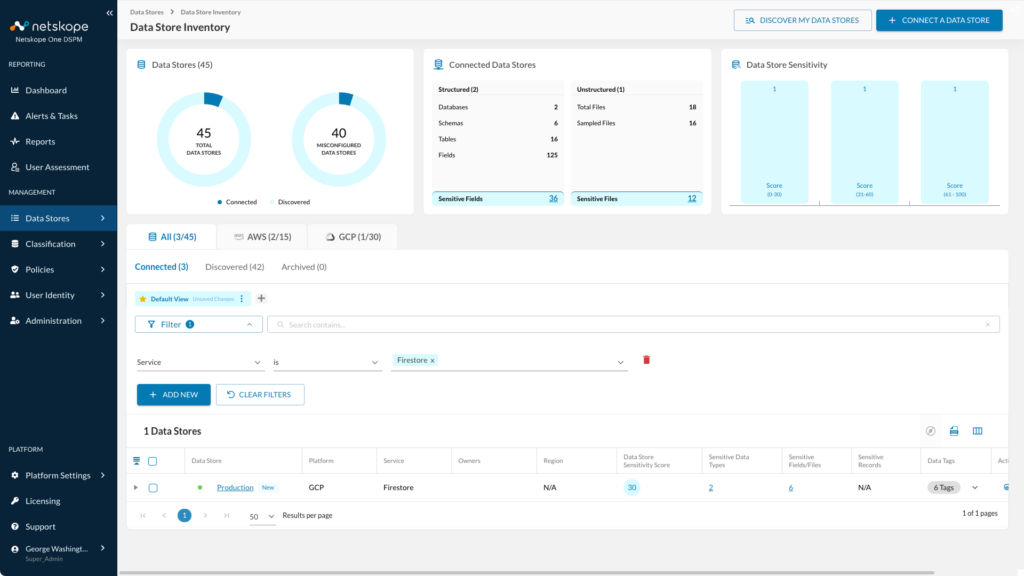
Netskope One AI Security secures users, agents, applications, and data across the AI ecosystem from a single platform. It covers workforce access to generative AI tools, privately built AI applications, and autonomous agents operating through APIs and MCP, applying visibility and protection from pre-deployment through runtime.
The platform treats AI traffic as another inspected channel alongside web, cloud, and private application traffic. That lets teams see which AI apps and MCP servers are in use, control what data can move into them, and inspect prompts and responses inline rather than relying on after-the-fact log review.
Key features include:
- AI Command Center: Provides visibility across the AI environment, from generative AI apps and AI features embedded in SaaS through to autonomous agents, with connected risk insights covering shadow AI, high-risk behavior, DLP violations, and AI threats.
- Shadow AI discovery: Detects unapproved personal and shadow AI apps and MCP usage across all environments in real time, with risk categorization drawn from a catalog covering hundreds of genAI apps and tens of thousands of SaaS applications.
- AI Guardrails: Inspects and sanitizes every prompt and response in real time as a unified defense against AI threats, misuse, and data loss across generative AI SaaS, private deployments, and agentic workflows.
- Agentic Broker: Secures autonomous, non-human interactions with unified visibility and control of public MCP servers, monitoring the MCP traffic behind agent activity to prevent unauthorized data access and risky connections.
- AI Gateway: Protects app-to-LLM API calls as data risk shifts from human prompts to autonomous application traffic, giving teams control over data moving between internal applications and models.
- DLP and DSPM for AI: Identifies and protects sensitive data across AI apps and cloud environments, preventing regulated data from feeding into models directly or through retrieval pipelines, with real-time user coaching on risky activity.
- AI Red Teaming: Automates adversarial simulations against private AI deployments from development through production to surface vulnerabilities before release.
- Granular access control: Policies determine who can use public and private AI apps and what data they can share, with controls that can permit prompts while preventing bulk uploads.
Limitations (as reported by users on G2): G2 lists reviews for the Netskope One Platform that delivers these AI capabilities.
- Deployment effort: Reviewers consistently describe initial deployment and policy configuration as time-consuming, often requiring professional services and dedicated internal resources.
- Learning curve: The breadth of features means new administrators need training before they are confident building policies and troubleshooting.
- Console usability: Several reviewers find the management interface cluttered and note that navigating between functions and generating custom reports can be slow.
- Integration clarity: Some users report ambiguity about what telemetry actually flows in integrations with third-party endpoint and security tools.
- Cost: Licensing is described as expensive relative to alternatives, with the economics working best for organizations consolidating several tools.
Source: Netskope

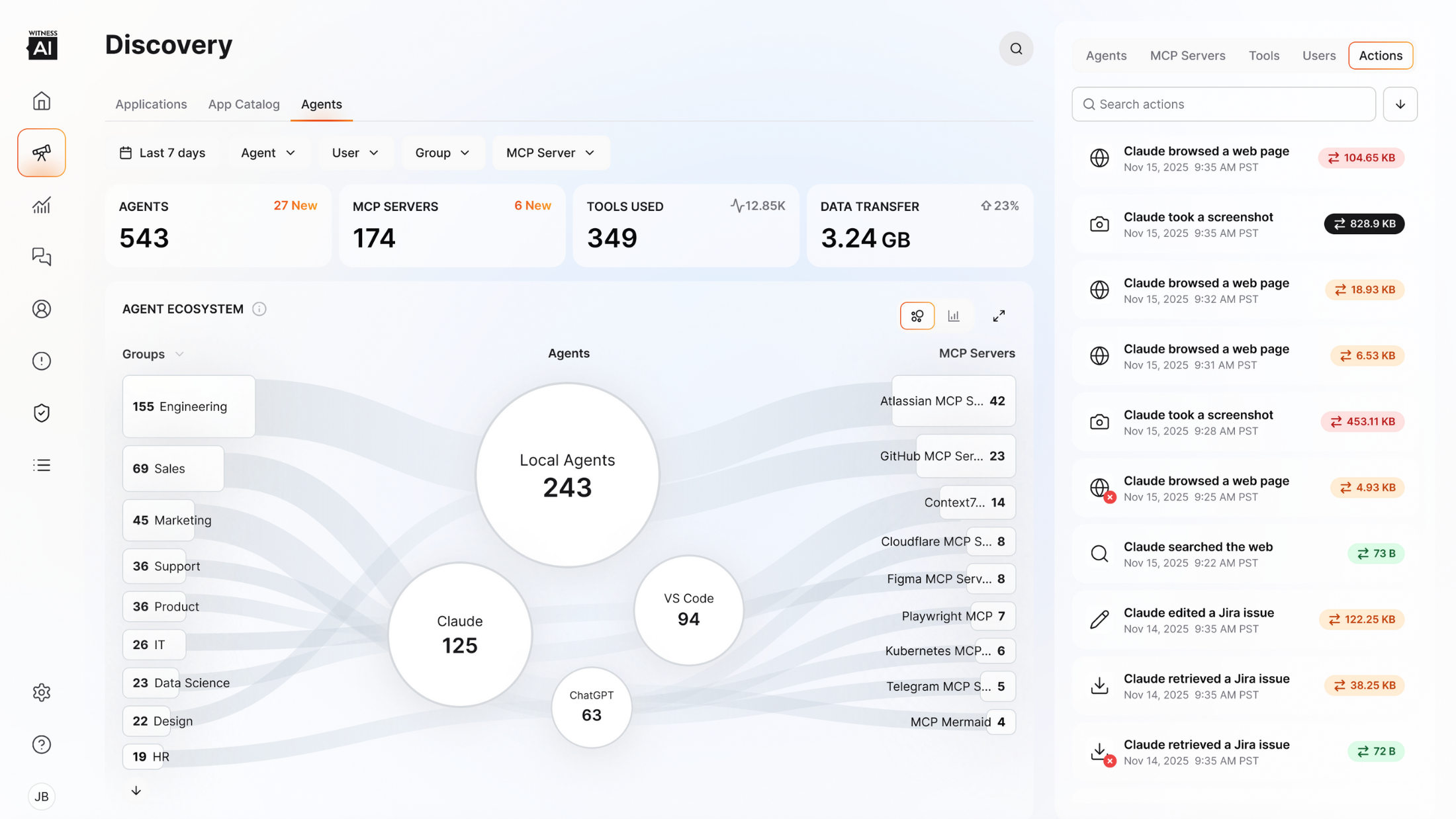
4. WitnessAI
Best for: Network-level governance of employee and agent AI activity
Strengths: Intent-based policy engine with bidirectional runtime AI defense
Things to consider: Coverage depends on network path; pricing not published
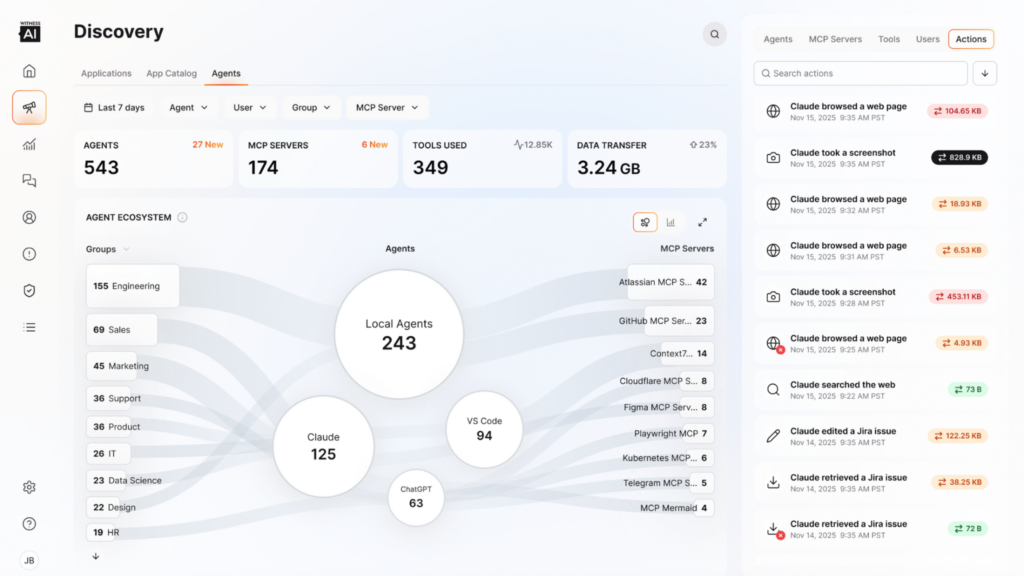
WitnessAI sits at the infrastructure layer between users and AI models, intercepting and analyzing AI interactions at the network level rather than through endpoint clients or browser extensions. The platform is organized into four modules: Observe, Protect, Control, and Attack, governing employees and AI agents through a single policy engine.
Its distinguishing mechanism is intent-based classification. Instead of matching keywords or known malicious strings, machine learning models analyze the meaning and context of a conversation, which allows the platform to track patterns that develop across multiple turns and sessions rather than evaluating each prompt in isolation.
Key features include:
- Network-wide AI discovery: Scans the entire network for AI usage against a catalog of thousands of AI applications, showing which AI tools employees use, which agents are running, and associated AI spend, with intent and risk identified in real time.
- Native application coverage: Monitors desktop AI applications including Windows 11 Copilot and Office 365 without deploying endpoint clients or browser extensions, closing a common visibility gap for non-browser AI use.
- Intent-based classification: Machine learning models analyze conversations and context to detect behavior that evolves across sessions, identifying suspicious activity from employees and agents alike rather than relying on pattern matching.
- Runtime AI defense: Bidirectional protection blocks threats such as prompt injection before they reach models and agents, and filters harmful outputs before they reach users or trigger downstream actions.
- Integrated guardrails: Data protection tokenizes sensitive information, model protection defends against manipulation, and agent guardrails enforce rules of engagement for autonomous systems.
- Agent tool-access governance: Maintains an organization-wide approved list of MCP servers and tools enforced at the network for every agent across IDEs, chat apps, and custom-built agents. Organization-level bans cannot be re-enabled by a team admin, and every blocked tool call generates an audit record naming the user, agent, tool, and rule.
- Intelligent routing: Routes requests from employees and agents based on risk, cost, and purpose, directing sensitive queries to secure internal models while sending routine tasks to lower-cost options.
- Enterprise deployment architecture: Single-tenant isolation, customer-controlled encryption, executive privacy modes, and multi-region deployment address data sovereignty requirements.
Limitations (based on publicly available sources):
- Network-path dependency: The platform operates between users and models at the infrastructure layer, so coverage depends on AI traffic traversing the deployed network path.
- Enterprise-oriented fit: Positioning targets large organizations in regulated industries, which makes it a heavier fit for smaller security teams.
- Pricing not published: Costs are quote-based and not listed publicly, requiring a sales engagement to scope.
- Limited independent validation: Growth and adoption figures come from company announcements rather than audited or peer-reviewed sources, and coverage on major review platforms remains thin.
Source: WitnessAI
AI Application, Model, and Agent Runtime Defense
5. Palo Alto Networks Prisma AIRS

Best for: Securing AI apps, models, and agents across the AI lifecycle
Strengths: AI Gateway, runtime safeguards, model scanning, and red teaming
Things to consider: Some features still maturing; complex packaging and licensing
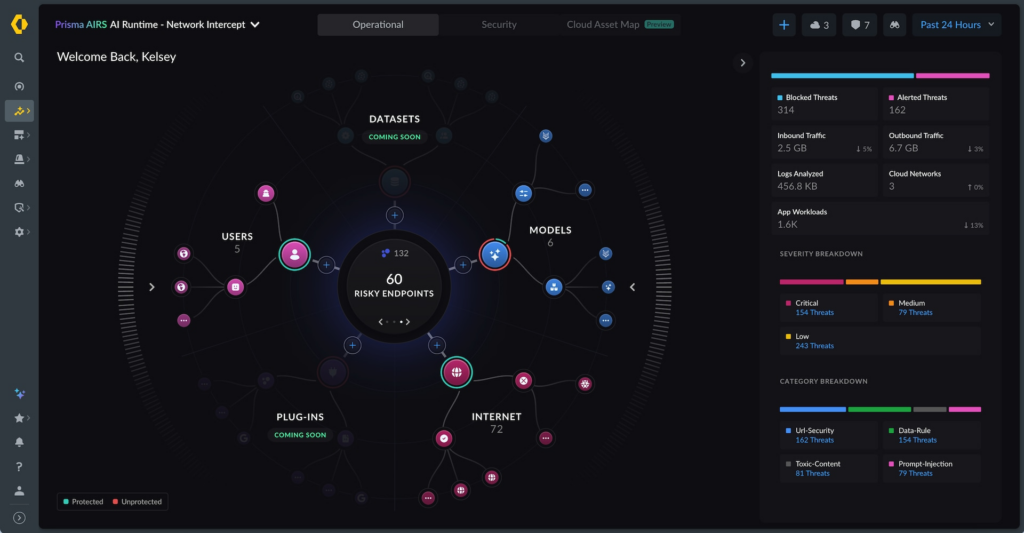
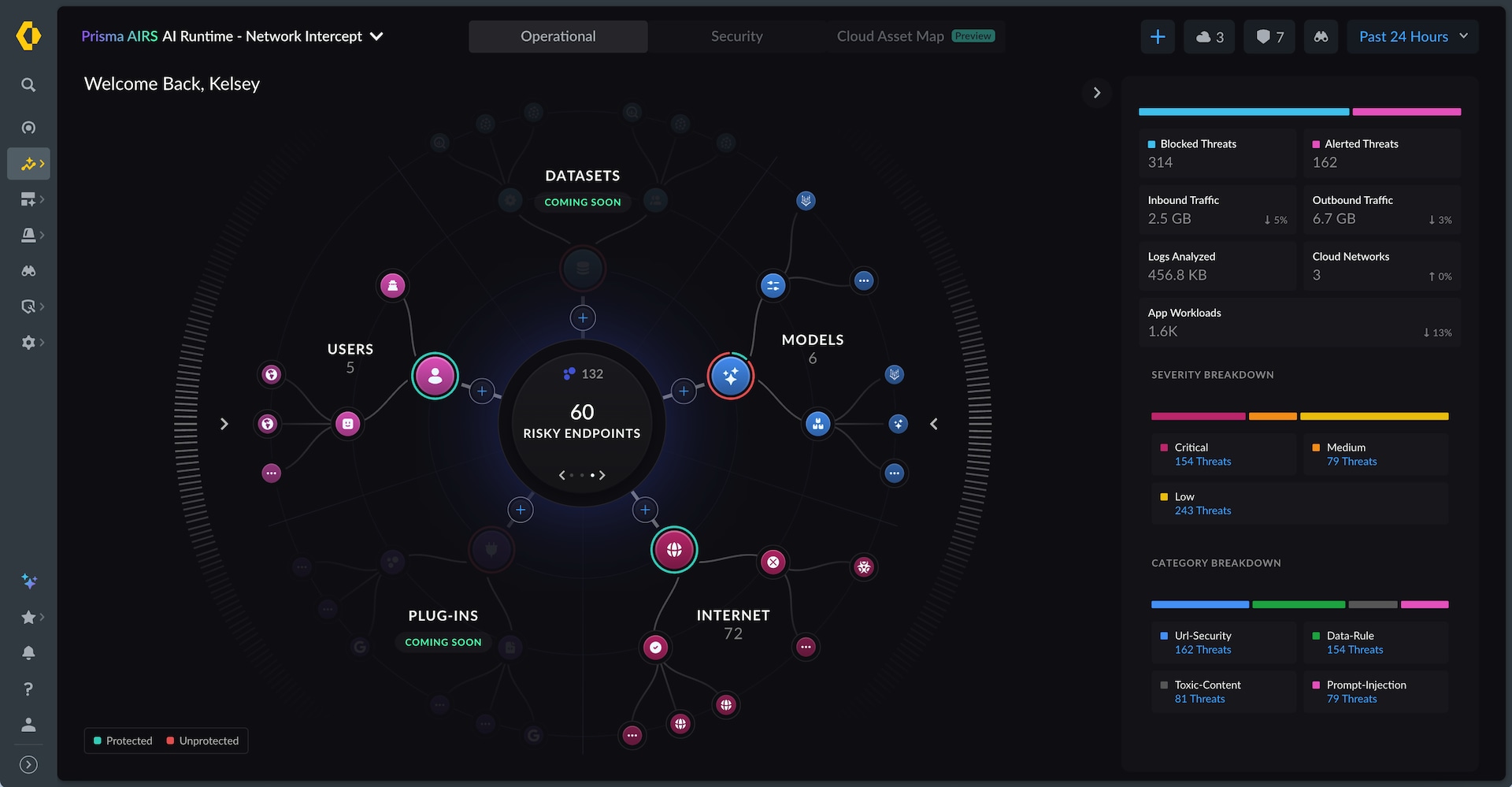
Prisma AIRS is Palo Alto Networks’ platform for discovering, assessing, and protecting an AI ecosystem from one place. It spans three phases: discovering shadow AI and mapping how agents, apps, and models connect; continuously testing them and monitoring posture; and enforcing AI-specific controls at runtime.
For real-time monitoring and defense, the relevant components are AI Runtime Security and Agent Security. The first monitors AI behavior and applies safeguards during live interactions. The second verifies agent identity and enforces controls on agent actions as deployments scale from pilot to production.
Key features include:
- AI Runtime Security: Monitors AI behavior during live interactions and enforces real-time safeguards intended to prevent manipulation, data exposure, and unsafe actions while sessions are in progress.
- Agent Security: Verifies every agent identity and applies real-time controls to stop unauthorized actions, aimed at organizations moving agent deployments from pilot into production.
- AI Gateway: A control plane for discovering, governing, and securing enterprise AI activity from a single point, now generally available.
- Shadow AI discovery: Provides visibility into every AI agent, application, and model in the environment and maps how they connect to one another.
- AI Model Security: Scans third-party models for vulnerabilities including model tampering, malicious scripts, and deserialization attacks before they are adopted.
- AI Posture Management: Covers the data used for training or inference, the integrity of AI agents and applications, and access to deployed models, with continuous testing and permission controls.
- AI Red Teaming: Simulates real-world attacks against AI agents and applications, with support for multi-turn attacks, agentic target profiling, and testing of autonomous and multi-agent systems.
- Violation reporting: Surfaces threat snippets within violations, provides an API violations view, and classifies toxic content across eight categories.
Limitations (as reported by users on Gartner Peer Insights):
- Feature maturity: Reviewers describe some capabilities as early-stage or limited, with certain functions still under development.
- Alert and report tuning: Alerts and reports often need extra configuration to fit a specific environment, which reviewers say adds manual work.
- Integrations and customization: Users note the platform feels immature in these areas and that documentation for advanced use cases could be expanded.
- Onboarding effort: Reviewers report a learning curve before teams get full value from the platform.
Source: Palo Alto Networks
6. Cisco AI Defense
Best for: Enterprises both building and using AI across multicloud environments
Strengths: Network-embedded guardrails, AI validation, and asset inventory
Things to consider: Best value inside a Cisco stack; documentation can be dense
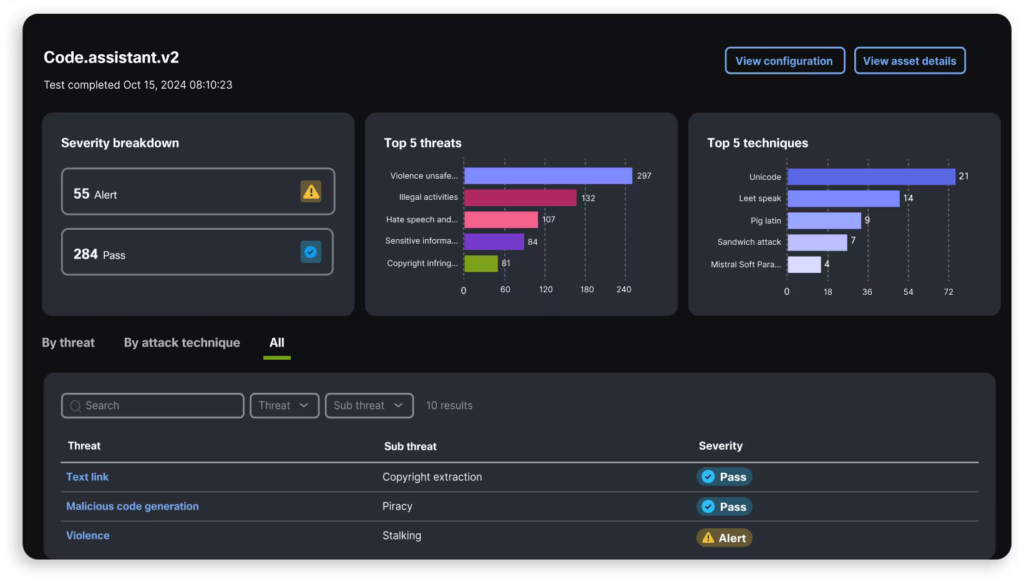
Cisco AI Defense addresses two distinct problems from one product: employees using third-party AI applications, and internal teams developing AI applications and agents. On the usage side it surfaces third-party AI apps in use and applies access and data policies. On the development side it detects AI assets, tests models for vulnerabilities, and deploys guardrails.
Enforcement is delivered through the network fabric rather than through agents or libraries installed alongside AI workloads. Cisco positions this as decoupling AI development from security, since guardrails apply to traffic without requiring changes to individual applications.
Key features include:
- AI Runtime Protection: Guardrails embedded in the network block adversarial attacks and harmful responses in real time, covering prompt injection, denial of service, and data leakage against production AI applications.
- AI Access: Monitors and manages access to third-party AI applications, automatically surfacing which AI tools are in use across the organization and enforcing policies that limit sensitive data exposure.
- AI Cloud Visibility: Automatically inventories AI models and connected data sources across distributed cloud environments to establish usage patterns and gauge risk.
- AI Model and Application Validation: Uses algorithmic red teaming to identify safety and security vulnerabilities across models at scale, with results returned in seconds rather than through manual testing cycles.
- AI Supply Chain Risk Management: Applies governance and security controls over AI models and files entering the environment, including scanning of model components and MCP servers.
- Agentless network-level enforcement: Security is applied at the network layer without requiring agents or libraries, giving visibility into AI traffic across the distributed environment.
- Advanced detection categories: Guardrails extend past prompt injection and malicious URL detection to model denial of service, code detection, and off-topic attacks.
- Threat intelligence and standards alignment: Detections are informed by Cisco’s AI research lab and Talos with platform updates pushed for emerging attacks, and a single integration maps to NIST, MITRE ATLAS, and the OWASP LLM Top 10.
Limitations (based on publicly available sources):
- Ecosystem dependency: AI Defense is delivered as part of Cisco’s broader security platform, so the operational and commercial case is strongest for organizations already standardized on Cisco.
- Usability of documentation: Reviewer commentary indicates the documentation and some features are powerful but difficult to apply correctly without support.
- Package fragmentation: Capabilities are split across subscription packages such as Advantage, Validation Essentials, and Runtime Essentials, so buyers need to confirm which functions their tier includes.
- Usage-based metering: Subscription pricing is based on the quantity of AI applications protected, along with usage and deployment model, which makes forecasting dependent on how AI adoption scales.
- Contractual restrictions on validation output: Attack prompts and related reports generated by AI Validation may not be used to train models or build competing products.
Source: Cisco

7. HiddenLayer AI Runtime Security

Best for: Runtime defense for AI applications, coding agents, and workflows
Strengths: Agentic runtime visibility with inline detection, blocking, and redaction
Things to consider: Model-centric scope; strongest when the full platform is adopted
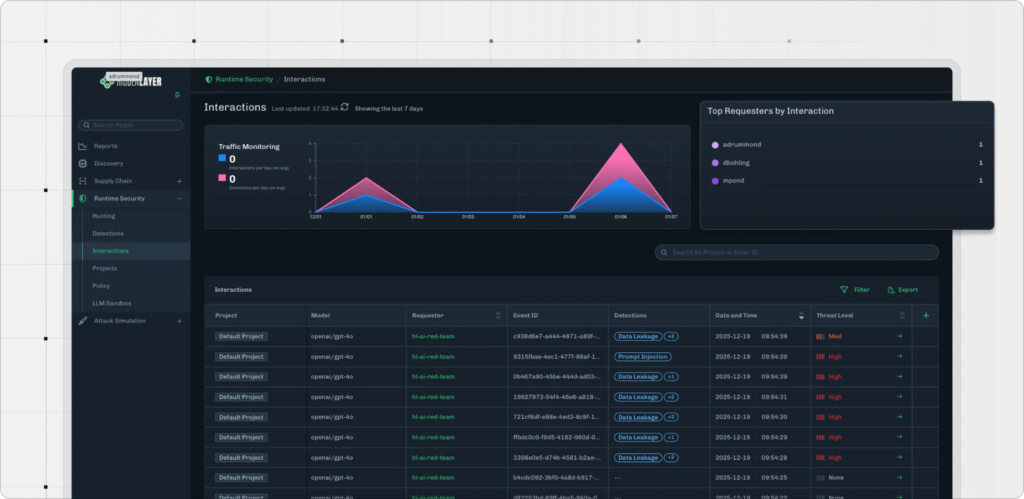
HiddenLayer AI Runtime Security protects AI applications, agents, and agentic workflows while they operate, combining runtime visibility, threat detection, and inline enforcement. It targets three specific runtime risks: prompt injection and indirect attacks through retrieved content or tool output, sensitive data exposure by agents, and unsafe or unauthorized agent actions.
The module is one of four in HiddenLayer’s platform, alongside AI Discovery, AI Supply Chain Security, and AI Attack Simulation. Runtime detections and enforcement events feed into existing security operations workflows rather than living in a separate console.
Key features include:
- Continuous runtime monitoring: Maintains real-time awareness of AI activity across every AI endpoint, application, and agent workflow to support investigation while systems remain in operation.
- Agentic runtime visibility: Observes and reconstructs agent interactions across tools, data, and workflows in real time, so teams can trace what an agent did and in what order.
- Agentic threat detection: Detects and investigates prompt injection, unsafe agent behavior, sensitive data exposure, malicious tool use, and other runtime threats specific to AI systems.
- Inline protection: Detects, blocks, or redacts unsafe actions and sensitive information according to policy, with the available enforcement actions depending on platform capabilities.
- Agent harness security: Extends runtime security into AI coding agents through a lightweight, on-device integration rather than requiring changes to the agent itself.
- Security operations integration: Runtime detections and enforcement events flow into existing SIEM, SOAR, and security operations workflows.
- AI Discovery: Provides visibility into AI assets across environments to eliminate shadow AI, including where models are used, by whom, and with what level of access.
- Supply chain and attack simulation modules: Validate model integrity before deployment and run continuous simulated attacks to surface weaknesses ahead of production.
Limitations (based on publicly available sources):
- Scope of coverage: The platform is centered on models, applications, and agents rather than workforce SaaS and endpoint AI usage, so it typically sits alongside a separate control for employee AI activity.
- Value tied to full adoption: Independent analyses note the platform’s individual capabilities are less differentiated as a point purchase, with the strongest case coming from adopting it end to end.
- Deployment work for coding agents: Extending runtime security into AI coding agents requires an on-device integration in developer environments.
- Pricing not published: There is no public pricing page; quotes are scoped to model count, deployment size, and which modules are purchased.
Source: HiddenLayer
.webp)
8. Noma Security Runtime Protection

Best for: Real-time detection and response for AI applications and agents
Strengths: Context-aware policy enforcement at the point of execution
Things to consider: Enterprise-scoped; policies benefit from paired posture module
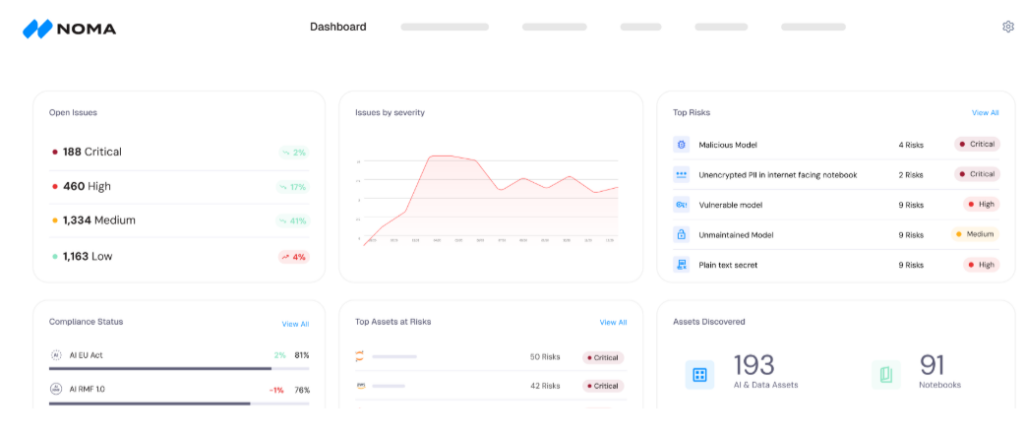
Noma Runtime Protection is an AI detection and response layer that monitors AI interactions as they happen and enforces security, privacy, and compliance policies at the point of execution. Detection models analyze prompts, responses, tool calls, and agent behaviors, then detect, mask, or block before an action reaches the model or a downstream system.
The design assumption is that static analysis cannot address what happens in production, where agents make autonomous decisions continuously and every prompt, tool call, and agent handoff is a potential attack path. Enforcement therefore happens inline rather than through log review after the fact.
Key features include:
- Full AI communication visibility: Monitors prompts and responses, agent tool calls, MCP server interactions, and agent-to-agent communications across the enterprise from a single view.
- Graduated response actions: Handles policy violations with real-time alerts and audit logging, sensitive data masking, or full request blocking, configurable by application, agent profile, risk level, or policy type.
- Proprietary detection models: The detection engine uses AI models trained specifically for security analysis to recognize attack patterns, policy violations, and anomalous AI behavior rather than relying on keyword matching or regular expressions.
- Sensitive data protection: Automatically detects and masks PII, credentials, API keys, and sensitive business data before it reaches AI models or leaves the environment, with masking applied in real time.
- Malicious tool and MCP detection: Identifies and blocks malicious tool calls, poisoned MCP servers, and unauthorized function executions by analyzing the command, its parameters, and the surrounding context before any tool runs.
- Granular policy scoping: Security, privacy, and compliance guardrails are applied by application, agent type, user role, data sensitivity, or business context, with each policy enforced at execution time.
- Complete audit trail: Every interaction, policy decision, and response action is logged and searchable, supporting traceability and automated reporting for auditors and regulators.
- Platform feedback loop: Asset discovery and risk scoring from Noma’s posture management module automatically configure runtime policies, and vulnerabilities found in red team testing become detection signatures and guardrail rules.
Limitations (based on publicly available sources):
- Dependency on the wider platform: Automatic runtime policy configuration relies on running the posture management module alongside Runtime Protection, so standalone deployments require more manual policy work.
- Optimization trade-off: Independent reviews position Noma as optimized for agent governance rather than low-latency prompt filtering, which matters for teams whose main requirement is input and output classification speed.
- Enterprise procurement cycle: Buyers should expect legal review, a security questionnaire, and a proof-of-value period during which the platform maps the AI inventory before contracting.
- Pricing not published: Costs are sales-gated and scoped by agents secured, MCP servers covered, integrations enabled, and deployment breadth across cloud providers.
- Limited independent validation: Growth, customer count, and risk-detection figures come from company announcements rather than audited sources, and peer review coverage remains sparse.
Source: Noma Security
Conclusion
As AI adoption accelerates, prioritizing real-time monitoring and defense is essential for safeguarding sensitive data and maintaining operational integrity. By implementing robust observability and automated guardrails, organizations can proactively identify threats and ensure the safe, compliant use of autonomous systems. These measures transform AI from a potential liability into a secure, strategic asset. Establishing these protections today positions enterprises to scale AI innovations with confidence and resilience.

Any worker. Any laptop. Any AI workflow. Fully secured.
Schedule a demo to see how Blue Border™ secures company data and apps without shipping laptops, running VDI, or managing personal endpoints.